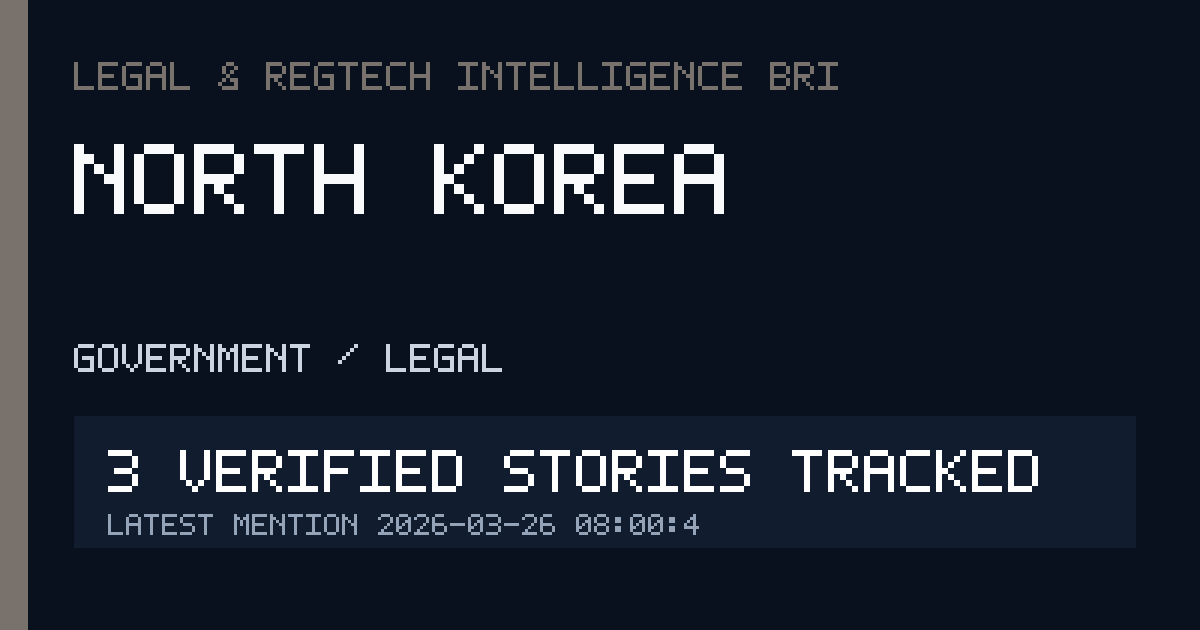
Every one of those 3 sits in a single category, regulation. Of the tracked stories, 2 of 3 also mention United States, the most common co-covered peer. That works out to roughly 0.7 stories per week across a 29-day span.
Figures are computed live from our source-verified story record
— see our methodology for how impact and
sentiment are derived.
What the coverage shows about North Korea
Every one of those 3 sits in a single category, regulation. Of the tracked stories, 2 of 3 also mention United States, the most common co-covered peer. That works out to roughly 0.7 stories per week across a 29-day span. The 7 average consequence score is above the beat benchmark of 6.5 in the same window. They are less corroborated than the beat average, carrying 2.7 original sources each against 3.1 for the same window. We currently track 3 Legal stories that mention North Korea, published between February 26, 2026 and March 26, 2026.
Stories tracked
3
Per week
0.7
Sources per story
2.7
Computed from the 3 stories linked to this entity, with beat comparisons drawn from all 1143 Legal stories published in the same date window. Shares are omitted below five stories and comparisons below a twenty-story baseline.
Coverage cohort
Appears alongside
Other entities that clear the same relevance threshold in stories also covering North Korea. Shared-story counts are live from our verified record — not editorial picks.
The signing of a comprehensive 'friendship and cooperation' treaty between North Korea and Belarus marks a significant consolidation of sanctioned states. This diplomatic alignment creates complex new challenges for RegTech providers and compliance officers tasked with monitoring illicit financial flows and dual-use technology transfers.
North Korea has signaled a hardline stance on potential diplomatic re-engagement with the United States, demanding formal recognition as a nuclear-armed state and the removal of economic sanctions. Following a series of ballistic missile tests, analysts suggest Kim Jong-un is leveraging geopolitical instability to force Washington into a conciliatory negotiating position.
North Korean leader Kim Jong Un has formally designated South Korea as a 'primary foe,' threatening total destruction while maintaining a strategic opening for direct negotiations with the United States. This shift from reunification rhetoric to a two-state hostile reality necessitates a significant recalibration of regional sanctions compliance and geopolitical risk modeling.