Every one of those 4 sits in a single category, regulation. Of the tracked stories, 3 of 4 also mention China, the most common co-covered peer. At 7.5, the average consequence score sits above the same-window beat average of 6.5.
Figures are computed live from our source-verified story record
— see our methodology for how impact and
sentiment are derived.
What the coverage shows about Taiwan
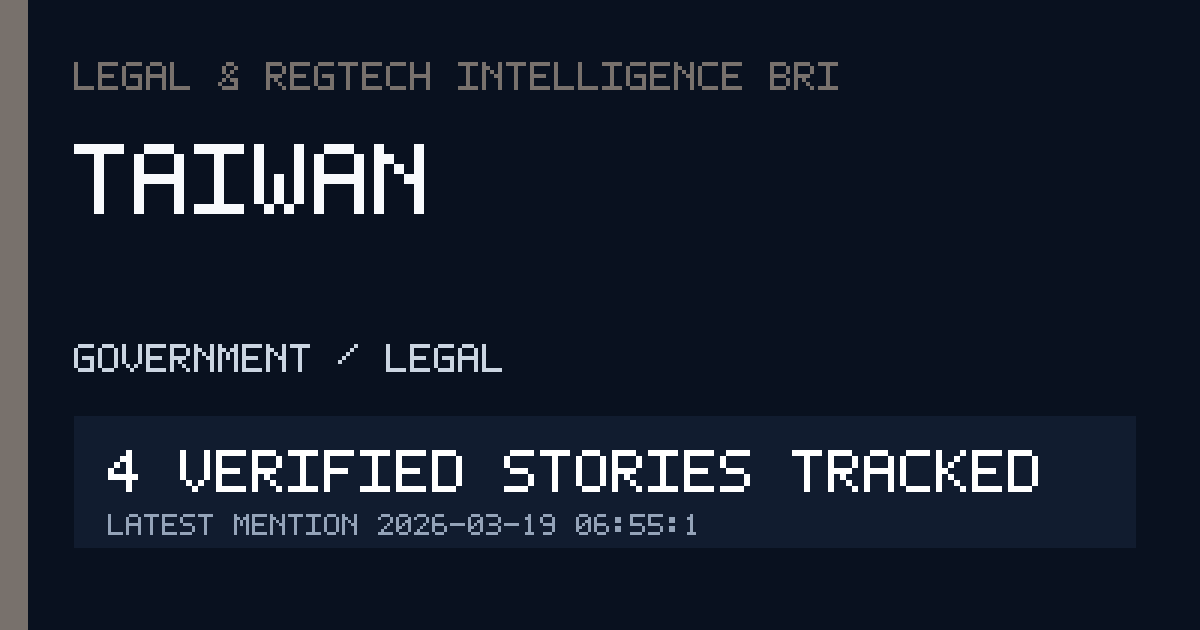
Every one of those 4 sits in a single category, regulation. Of the tracked stories, 3 of 4 also mention China, the most common co-covered peer. At 7.5, the average consequence score sits above the same-window beat average of 6.5. Source depth averages 2.3 original sources per story, versus 3 across the same-window beat baseline. That works out to roughly 1.1 stories per week across a 26-day span. We currently track 4 Legal stories that mention Taiwan, published between February 22, 2026 and March 19, 2026.
Stories tracked
4
Per week
1.1
Sources per story
2.3
Computed from the 4 stories linked to this entity, with beat comparisons drawn from all 961 Legal stories published in the same date window. Shares are omitted below five stories and comparisons below a twenty-story baseline.
Coverage cohort
Appears alongside
Other entities that clear the same relevance threshold in stories also covering Taiwan. Shared-story counts are live from our verified record — not editorial picks.
A new U.S. intelligence assessment indicates that China is not currently planning a military invasion of Taiwan by the previously feared 2027 deadline. This recalibration of geopolitical risk provides a critical window for legal and compliance departments to transition from emergency contingency planning to long-term regulatory resilience.
President Trump has delayed a high-stakes diplomatic mission to Beijing by one month to prioritize the escalating conflict with Iran. This postponement signals a shift in US foreign policy that could reshape international trade regulations, maritime security protocols, and the enforcement of sanctions against Tehran.
The United States has launched a sweeping Section 301 investigation into the trade practices of 16 key partners, including Taiwan, the European Union, China, and India. This aggressive regulatory move signals a significant shift in US trade policy, potentially leading to broad tariffs and reshaped international commercial legal frameworks.
Policy experts are urging Taiwan to proactively develop a legal and regulatory defense strategy against a potential U.S. Section 301 investigation. The warning highlights the risk of unilateral trade sanctions as the U.S. looks to address trade imbalances and intellectual property concerns.