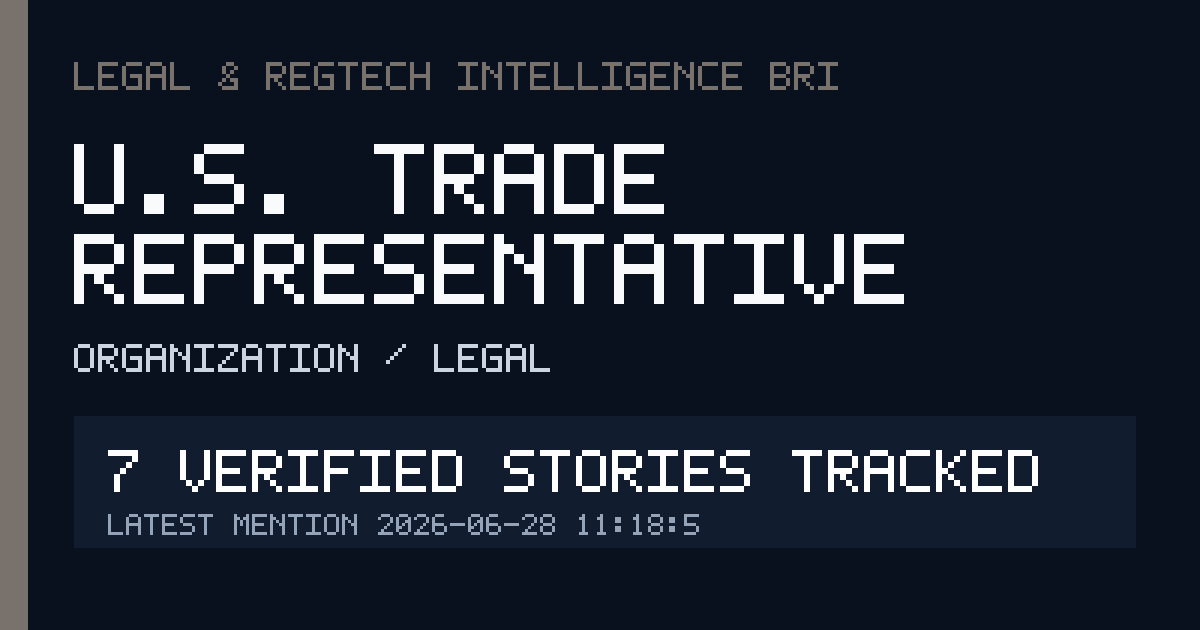
regulation is the sole category represented across all 7 tracked stories. Donald Trump is the most frequent co-covered peer, appearing in 4 of the 7 tracked stories. They are less corroborated than the beat average, carrying 2 original sources each against 3.3 for the same window.
Figures are computed live from our source-verified story record
— see our methodology for how impact and
sentiment are derived.
What the coverage shows about U.S. Trade Representative
regulation is the sole category represented across all 7 tracked stories. Donald Trump is the most frequent co-covered peer, appearing in 4 of the 7 tracked stories. They are less corroborated than the beat average, carrying 2 original sources each against 3.3 for the same window. The 165-day window averages about 0.3 stories each week. The busiest single day carried 2. The negative share is 43%, the same as the 43% benchmark across 1865 Legal stories in the same window. Their average consequence score of 6.4 sits level with the 6.4 recorded across the beat in that window. U.S. Trade Representative appears in 7 tracked Legal stories published from February 22, 2026 through August 5, 2026.
Stories tracked
7
Per week
0.3
Negative
43%
Sources per story
2
Computed from the 7 stories linked to this entity, with beat comparisons drawn from all 1865 Legal stories published in the same date window. Shares are omitted below five stories and comparisons below a twenty-story baseline.
Coverage cohort
Appears alongside
Other entities that clear the same relevance threshold in stories also covering U.S. Trade Representative. Shared-story counts are live from our verified record — not editorial picks.
Doug Ford declares Ontario 'won’t back down' until the U.S. removes tariffs on steel, aluminum, and autos.
CANADA Act introduced
Rep. Claudia Tenney introduces the Combating Attacks on our National Alcoholic Drinks by Allies Act, requiring a Section 301 probe within 30 days of passage.
Expected USTR Response
The U.S. Trade Representative is expected to provide a formal response to the coalition's demands.
Coalition Formalized
Democratic Senator and Governors issue a joint call for immediate refunds and regulatory relief.
Implementation Date
Tariffs are scheduled to go into effect at 12:01 a.m. ET according to White House fact sheets.
Supreme Court Ruling & Warning
SCOTUS strikes down IEEPA tariffs; Trump warns countries not to 'play games' and EU postpones trade vote.
Escalation to 15%
Trump increases the rate to 15% via Truth Social, citing Section 122 authority.
SCOTUS Ruling
Supreme Court invalidates the administration's use of emergency powers for global tariffs.
10% Announcement
Trump announces a 10% global tariff in immediate response to the court's decision.
Initial Tariff Announcement
Trump announces a 10% temporary import duty under Section 122 of the Trade Act of 1974.
Exclusion Expirations
A significant number of temporary tariff exclusions expire, leading to immediate cost increases for importers.
Section 301 Implementation
The first wave of tariffs on Chinese goods is implemented, sparking the need for an exclusion process.
The U.S. bill seeking a Section 301 investigation into provincial alcohol restrictions tests the boundaries of trade law and state sovereignty. Rep. Tenney’s CANADA Act would force a probe within 30 days, potentially triggering retaliation and WTO challenges. Ontario’s Premier vows to maintain the ban until U.S. tariffs are lifted, setting up a legal standoff that could redefine trade enforcement.
Australia’s revised News Bargaining Incentive triggers fresh US condemnation as Trump administration calls it 'foreign extortion.' Legal experts examine the trade law implications and the expanding tax net to TikTok and LinkedIn.
The Trump administration pivots to Section 301 of the Trade Act of 1974 to impose 10-12.5% forced-labor duties on 60 trading partners, replacing IEEPA-based tariffs struck down by the Supreme Court. This legal shift offers greater durability against court challenges and WTO disputes, but trade counsel must navigate new compliance complexities.
A prominent Democratic senator and a group of governors have launched a formal push for the federal government to provide tariff refunds and broader regulatory relief for businesses. The coalition argues that current trade duties are stifling state-level manufacturing and infrastructure development.
Following a Supreme Court ruling invalidating tariffs under the International Emergency Economic Powers Act, President Trump has pivoted to Section 122 of the Trade Act of 1974. The administration is imposing a 15% temporary import duty while warning global trading partners against abandoning existing agreements.
US Trade Representative Jamieson Greer has confirmed that bilateral trade agreements remain legally binding despite a recent Supreme Court ruling against the administration's tariff authority. The statement aims to provide market certainty and prevent the unraveling of complex international trade frameworks.
President Donald Trump has escalated global import duties to a 15% maximum, pivoting to Section 122 of the 1974 Trade Act after the Supreme Court invalidated his previous emergency-power tariffs. This temporary measure faces a 150-day legislative deadline and significant skepticism from a Republican-controlled Congress concerned about inflation.