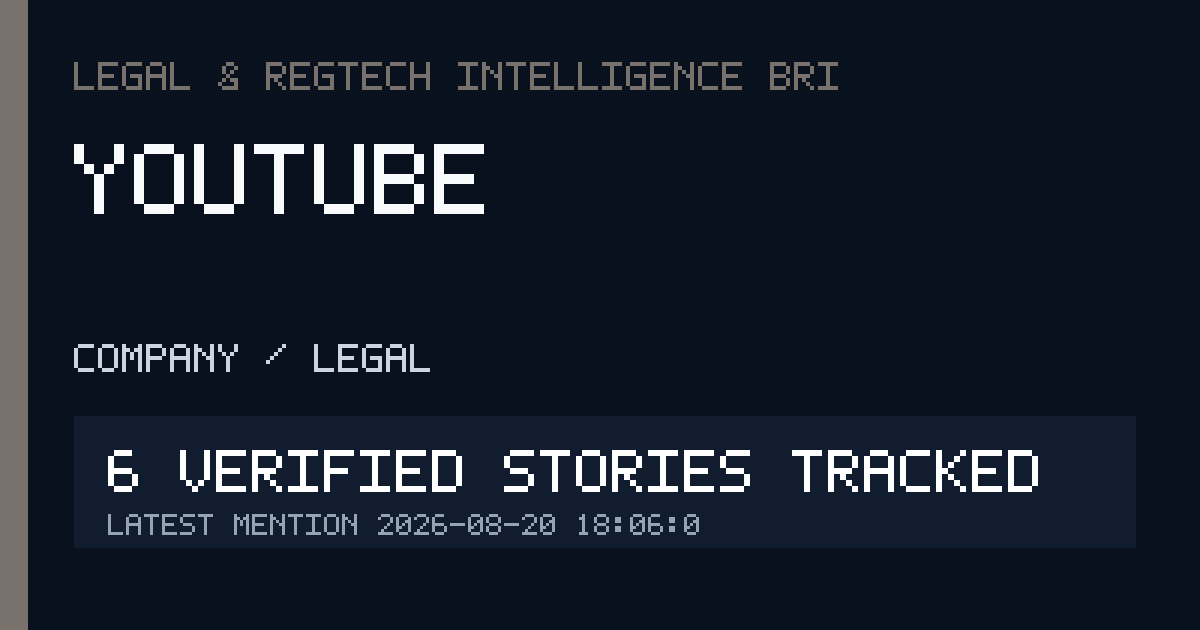
Across the most recent 6 stories covering YouTube — 33% positive, 33% negative, 33% neutral sentiment, averaging 6.5/10 impact.
This entity profile aggregates every story where the entity meets our minimum relevance
threshold before it is linked here — a story naming this entity only in passing, as
competitive context for an unrelated subject, does not qualify. That threshold exists
because earlier testing surfaced entity pages cluttered with tangential mentions: a story
about two unrelated companies merging could otherwise populate a third company's page
simply because it was named once for comparison, with no real event of its own. The
timeline below reflects genuine milestones and developments specific to this entity,
cross-referenced against the same source-verification standard applied to every story on
this site. Sentiment measures the directional read of each development for this entity
specifically, not the overall tone of the reporting, and impact weights how consequential
a development is rather than how widely it was syndicated across outlets.
Figures are computed live from our source-verified story record — see our methodology for how impact and
sentiment are derived.
Timeline
6th Circuit overturns injunction
A 2-1 panel rules the law does not violate the First Amendment and can be enforced.
Pilot Commencement
Pilot program officially begins for high-risk individuals and public officials.
Expansion Announcement
YouTube announces expansion of the tool to politicians and journalists.
Program Evaluation
Expected evaluation of pilot results for potential broader rollout.
Initial Launch
YouTube launches likeness detection for select content creators.
Law takes effect
The Social Media Parental Notification Act becomes effective in Ohio.
Preliminary injunction blocks enforcement
U.S. District Judge Algenon Marbley issues a preliminary injunction at NetChoice’s request, halting enforcement.
Ohio legislature passes Social Media Parental Notification Act
The law requires age verification and parental consent for users under 16 on social media platforms.
Russia has charged Telegram CEO Pavel Durov with aiding terrorism, adding him to international wanted lists and raising the possibility of life imprisonment. The case tests the boundaries of platform liability, extradition law, and state power over encrypted communications. Legal experts and tech executives worldwide are watching closely as the Kremlin weaponizes criminal law to control digital infrastructure.
The Qom court's 74-lash sentence against singer Parastoo Ahmadi for a hijab-free YouTube performance relies on Islamic Penal Code and Computer Crimes Law. A human rights lawyer argues the charges have no legal basis, as performing music is not a crime. The case sets a dangerous precedent for prosecuting artistic expression under authoritarian legal systems.
A split 6th Circuit upheld Ohio’s law requiring parental consent for under-16 social media use, finding it does not violate the First Amendment. The decision creates a blueprint for future challenges and sets the stage for Supreme Court review.
A California jury has found Meta and YouTube negligent in their application designs, awarding $3 million in damages to a young user for mental health distress. This landmark verdict marks a pivotal shift toward holding social media platforms liable for addictive product features rather than third-party content.
YouTube has launched a specialized reporting tool for public figures to flag AI-generated deepfakes that mimic their likeness. The move addresses growing legal and regulatory pressure on social media platforms to mitigate the risks of synthetic media and identity theft.
YouTube is extending its AI-powered deepfake detection tool to a pilot group of politicians, government officials, and journalists, allowing them to flag unauthorized likenesses. This move marks a significant shift in platform-led digital identity protection amid rising concerns over synthetic misinformation in democratic processes.
This page surfaces every story mentioning YouTube across our legal coverage. We track each entity's appearance over time so readers can trace how the narrative evolves — which developments are isolated incidents, which build into longer arcs, and which reframe how operators in the space think about the entity. Story selection uses the same multi-source verification gate applied across the rest of our coverage.
Read our editorial methodology for how we identify, deduplicate, and score entity references. Our glossary defines the technical terms used across stories on this page, and our trends index contextualizes individual developments against the longer-running legal beat. Cross-entity comparisons live on our compare view.
Entities only appear on this page once the classifier scores them at a minimum 35 percent
relevance to the story, filtering out passing mentions. According to that methodology,
reviewed July 2026, this follows multi-source corroboration standards recommended by
journalism research bodies such as the Reuters Institute for the Study of Journalism.
See something wrong on this page — a misattributed entity, a wrong stat, a broken source
link? Report a data issue.
What you see
What it tells you
Story count
Number of distinct stories where YouTube was a primary or referenced actor.
Recency clustering
Whether mentions are concentrated in a recent window (a news cycle) or distributed (a sustained arc).
Sentiment distribution
Aggregate sentiment of the stories mentioning this entity, weighted by impact score.
Cross-niche links
When the same entity surfaces in our sibling networks, we link to those views to enrich context.