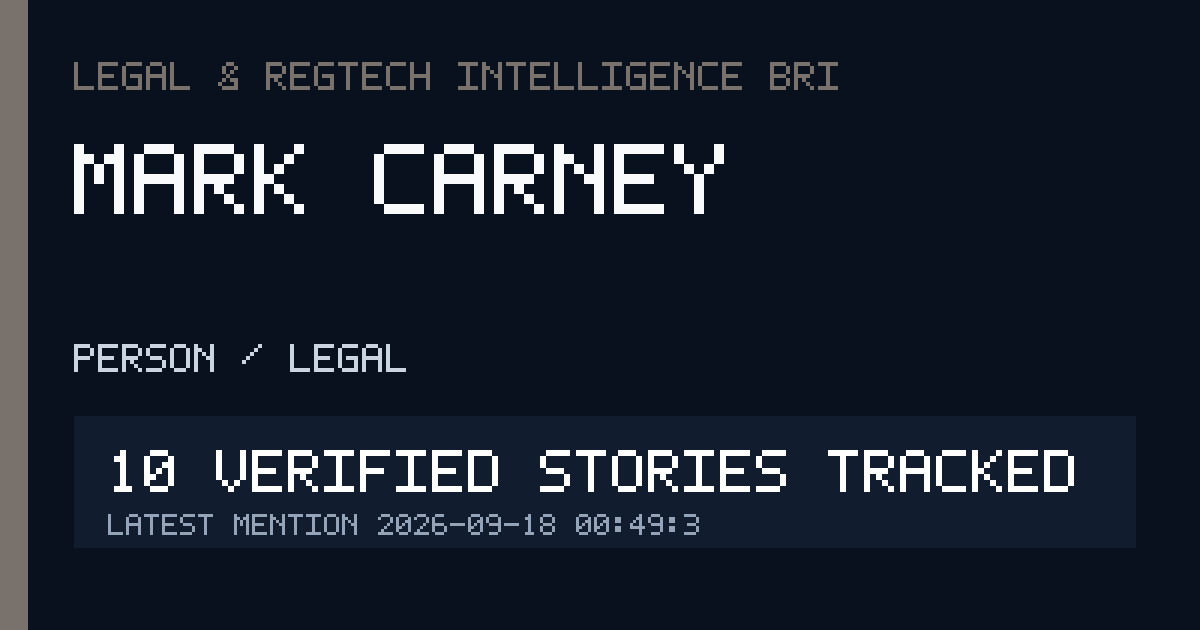
The clearest coverage concentration is regulation: 9 of 10 stories, with the rest divided among 1 other category. Of the tracked stories, 8 of 10 also mention Donald Trump, the most common co-covered peer. Sentiment skews more negative than the wider beat, at 50% negative against 39% across all 1795 Legal stories in the same window.
Figures are computed live from our source-verified story record
— see our methodology for how impact and
sentiment are derived.
What the coverage shows about Mark Carney
The clearest coverage concentration is regulation: 9 of 10 stories, with the rest divided among 1 other category. Of the tracked stories, 8 of 10 also mention Donald Trump, the most common co-covered peer. Sentiment skews more negative than the wider beat, at 50% negative against 39% across all 1795 Legal stories in the same window. Across a 187-day span, the pace is roughly 0.4 stories per week. The busiest single day carried 2. Their average consequence score of 6.5 runs above the beat's 6.3 for that window. They are better corroborated than the beat average, carrying 3.4 original sources each against 3.2 for the same window. Mark Carney appears in 10 tracked Legal stories published from March 7, 2026 through September 9, 2026.
Stories tracked
10
Per week
0.4
Negative
50%
Sources per story
3.4
Computed from the 10 stories linked to this entity, with beat comparisons drawn from all 1795 Legal stories published in the same date window. Shares are omitted below five stories and comparisons below a twenty-story baseline.
Coverage cohort
Appears alongside
Other entities that clear the same relevance threshold in stories also covering Mark Carney. Shared-story counts are live from our verified record — not editorial picks.
Ottawa's retaliatory duties, a response to the 50% U.S. tariffs, begin just after midnight EDT.
Trump signs five executive orders
Orders bar certain Canadian goods — motorcycles, some dairy, and alcoholic beverages — from U.S. government contracts, effective later this month.
Executive orders take effect
The five orders barring Canadian goods from U.S. government contracts come into force later in September 2026.
50% tariffs imposed; Canada retaliates and suspends talks
The U.S. imposed 50% tariffs on billions of dollars of Canadian exports after no deal was reached; Carney announced matching dollar-for-dollar tariffs, suspended negotiations, and summoned negotiators back to Ottawa.
USTR says Canada declined to finalize deal
In a press call shortly before midnight, USTR Jamieson Greer says Canada introduced new demands and walked back commitments, upending the balance reached in prior days.
Officials signal apparent compromise
U.S. and Canadian officials sounded as if they were headed toward a compromise on trade terms, according to sources.
Tariffs take effect
After the 30-day notice period, the 50% duties become effective on the listed Canadian products.
Trump extends trade deadline
Earlier in the week (week of August 17, 2026), President Trump imposed an extended deadline for a new Canada-U.S. trade agreement.
LeBlanc Expected Return to Washington
Dominic LeBlanc is scheduled to return to Washington on Monday to continue trade discussions.
Dairy Farmers Warn Against Concessions
Dairy Farmers of Canada issues a public warning not to offer further concessions; Trade Minister LeBlanc departs Washington after meetings.
PM Carney Affirms Supply Management Loyalty
Prime Minister Mark Carney states his government is 'loyal' to the supply management system, providing political support amid negotiations.
U.S. imposes 50% tariffs under Section 338
Washington levies 50% duties on Canada, accusing it of unfair treatment; bilateral negotiations fall apart.
US announces 50% tariffs on Canadian goods
President Trump invokes Section 338 of the Tariff Act of 1930, targeting $20B in imports ranging from wine to cement, and sets a 30-day implementation window.
Federal Lawsuit Announced
Mathur, Maltais, and Barnea hold a press conference in Ottawa to announce a new lawsuit against the federal government under Prime Minister Mark Carney for illegal rollbacks of environmental protections.
G7 working session in Evian-les-Bains
Carney, Trump, Starmer and Macron met at the G7 summit in France, weeks before the Canada-U.S. trade talks collapsed.
Regulatory Adjustment
Potential updates to SEMA and export control regulations in response to conflict levels.
Expected Policy Review
Anticipated briefing of the House of Commons Standing Committee on Foreign Affairs.
Carney's Public Warning
Mark Carney signals Canada's potential role in supporting NATO allies in the Middle East.
USTR Annual Report Cites Canadian Barriers
The Office of the United States Trade Representative published its annual report, highlighting Canadian market access barriers for alcohol and reiterating demands for improved dairy access.
Carney warns of U.S. intentions
In spring 2025, Prime Minister Mark Carney warns that 'America is trying to break us so they can own us' — a warning he restated in a video on September 8, 2026.
Trump's five executive orders invoke Section 338 of the Tariff Act of 1930 — never before used this way — to bar Canadian goods from U.S. contracts, opening novel questions of statutory interpretation and executive authority that could shape trade law for years.
Trump's 50% levy on $20 billion of Canadian goods revives Section 338 of the 1930 Tariff Act and reaches products once shielded by the USMCA, creating immediate statutory and treaty-conflict questions for trade counsel.
The U.S. has imposed 50% tariffs on $20B of Canadian goods, and Canada promises dollar-for-dollar retaliation. Trade lawyers face immediate questions over USMCA enforcement, WTO remedies, and tariff classification.
Canada-U.S. trade talks collapsed after the U.S. imposed 50% tariffs, triggering dollar-for-dollar Canadian retaliation and a suspension of negotiations. For counsel, the rupture raises questions about treaty enforcement, dispute settlement under CUSMA, and the legality of Canada's prohibitions on American goods.
As the US prepares 50% tariffs on Canadian goods with no CUSMA exemptions, dairy farmers are pressing Ottawa to hold firm on supply management, citing trade law and food sovereignty. The legal battle over USMCA compliance and direct market access threatens to escalate into a broader trade dispute.
Youth climate activists, led by Sophia Mathur, have launched a new federal lawsuit against Prime Minister Mark Carney’s government, alleging that recent environmental rollbacks are illegal and unconstitutional. This expands Canada’s youth climate litigation landscape beyond the ongoing 2019 Ontario case, raising fresh questions about the justiciability of climate rights under the Charter.
The US invokes a dormant 1930 trade law to impose 50% tariffs on $20B of Canadian imports, raising novel legal questions about USMCA compatibility and potential WTO challenges.
Senator Moreno’s proposed sanctions on Canada for cross-border wildfire smoke will likely fail in the Senate due to the 60-vote filibuster requirement, highlighting the legal and political challenges of legislating accountability for transboundary environmental harm.
President Trump's threat to impose tariffs on Canada over cross-border wildfire smoke opens a complex legal front at the intersection of trade law, environmental regulation, and presidential authority. Legal experts are scrutinizing whether such a move can survive challenges under the WTO, USMCA, or US statutes like IEEPA.
Mark Carney has signaled that Canada may be called upon to support NATO allies as Middle East tensions escalate, a move with profound implications for international trade law and sanctions compliance. This development suggests a shift toward a more active geopolitical stance, requiring legal and RegTech sectors to prepare for rapid regulatory changes.